

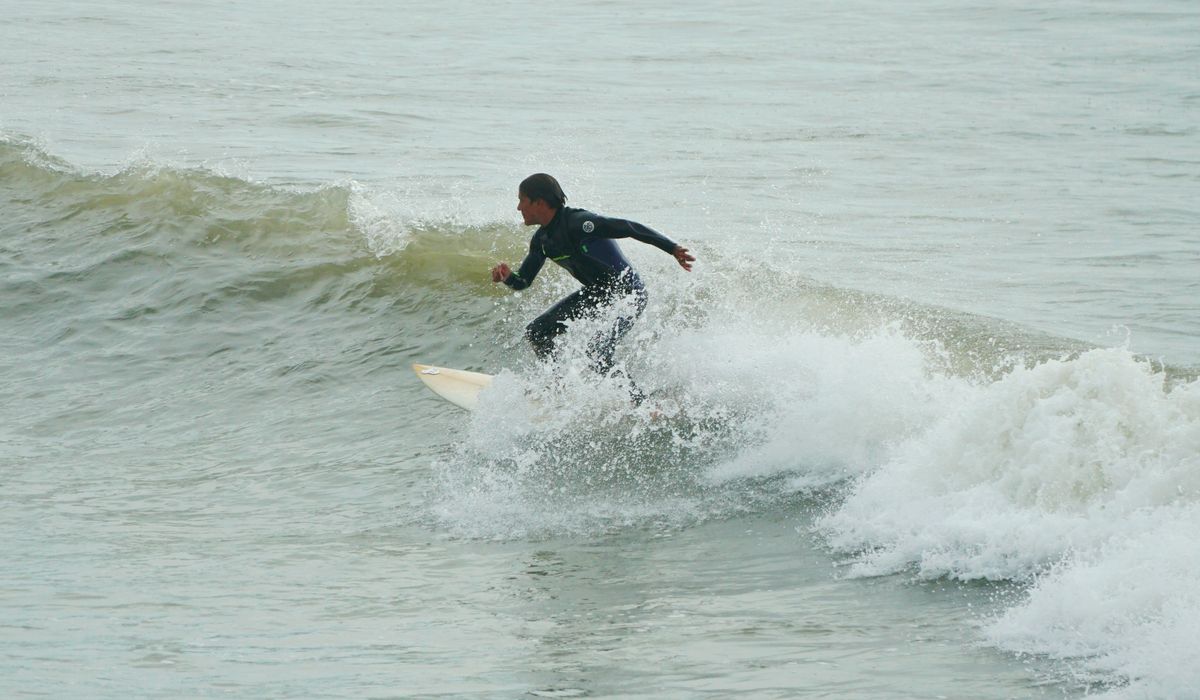
Why the tide matters more than almost anything else
You can wake to a clean, glassy forecast, drive two hours, and find the waves you imagined replaced by a sloppy closeout or a punishing shore dump. Nine times out of ten the culprit isn't the swell — it's the tide. The sea around the UK rises and falls roughly twice a day in a cycle that takes about 12 hours and 25 minutes, and that constant movement of water over the seabed reshapes every wave that breaks on it. A swell that works beautifully at high water may be completely unusable at low, and the reverse is just as true. Learning to read a tide table is the cheapest upgrade you can make to your surfing.
What the tide is actually doing to your wave
Waves break when the water shallows and the wave feels the seabed. Change the depth of the water and you change where that happens, how abruptly it happens, and how much of the wave's energy is released at once.
- Low water: less depth, so waves feel the bottom earlier and break faster and steeper. Expect punchier, hollower waves — and, on a steep beach, a hard shorebreak that's easy to get slammed in.
- High water: more depth, so waves stand up later and with less urgency. Brilliant for longboarders and newer surfers on gentle beaches, but on reefs and points the extra water can make a once-hollow wave fat and slow.
- Mid tide: the compromise most of us chase. Plenty of beaches that close out at both extremes come alive on a pushing or dropping mid tide.
Current changes too. The bigger the tidal range, the faster the water moves, and the more the wave's shape — and your place in the lineup — will shift across a two-hour session.
Beach breaks, reefs and points don't obey the same rules
Beach breaks are the most tide-sensitive because the sandbanks themselves move. A bank that's working beautifully at three-quarter tide can turn into a wall of white water once the sea drops another metre over the same spot, or a backless ripple at the top of the tide.
Reef breaks tend to have a narrow window. Too much water and the wave never feels the reef — it rolls through fat and unbroken. Too little and you're looking at a dry reef, exposed urchins and a genuine risk of injury. Some reefs need a big spring high; others only come alive on the bottom half of the tide.
Point breaks are more forgiving but still fussy. Many need water over the inside section to link the ride through, and a well-known hazard is being caught inside on a dropping tide with the rocks getting hungrier by the minute. Ask someone who surfs it weekly which stage of the tide the point actually works — it's rarely the whole six hours.
Springs, neaps and the strength of the push
Tides don't simply go in and out; they go in and out further on some days than others. When the sun and moon line up — around the new and full moon — you get spring tides, with the biggest range of the month. Quarter moons bring neap tides, the smallest.
In Britain that range is dramatic. Some Cornish beaches swing four to five metres, while the Bristol Channel regularly exceeds ten. On a spring tide the water can be two or three metres higher at the same point in the cycle than it was a week earlier — the difference between a session and a shut-out. Spring tides also bring stronger tidal streams and more aggressive rips, so treat a spring low over a shallow reef with real caution. Neaps, by contrast, give you gentler movement and longer windows, though often less punch.
How to read a tide table properly
Tide tables give you high and low water times and heights for a primary port, plus offsets for nearby secondary locations. A few habits make them far more useful:
- Think in hours from the tide, not clock time. "Two hours after low water" usually translates better between spots than "10am".
- Water doesn't move at full speed all at once. The middle of the flood and ebb is rarely the best of it; the sweet spot is often the last hour of the push or the first of the drop.
- Check the range as well as the times. A low of 0.4 metres and a high of 4.9 metres is a completely different day from 2.0 and 3.2, even when the times match.
- Access changes too. Some coves and cliff paths are only reachable near low water; others flood at the top of a spring tide. Plan your exit, not just your entry.
Simple habits that pay off
Keep a note of where you surfed, the tide stage, the swell and how it went. After a season you'll have a personal tide chart no app can match. Watch what the sea does over a full cycle at your local break, ask the people who surf it weekly, and remember that wind against tide chops a swell up while wind with the tide leaves it cleaner — but often softer.
Above all, give yourself a window rather than a single slot. Arrive two hours before low water and you can surf the whole turn of the tide, seeing for yourself what the bank is doing as the depth changes. That's the real skill: not just knowing the tide, but knowing your break at every stage of it.


Coding is used in almost all aspects of life and work now, be it directly or indirectly. It’s not just for companies in the tech sector. “An increasing number of businesses rely on computer code,
Coding is used in almost all aspects of life and work now, be it directly or indirectly. It’s not just for companies in the tech sector. “An increasing number of businesses rely on computer code,
Coding is used in almost all aspects of life and work now, be it directly or indirectly. It’s not just for companies in the tech sector. “An increasing number of businesses rely on computer code,